Archive for March, 2010

  • Google has worked its way to being one of the most audacious companies of all time, for its genius in customizing data for individual use. But in choosing to pick a fight with China over a business impediment presented as a lofty principle, that of defending Internet freedom, it could emerge eventually that Google thought itself too big to push. Even for a widely admired firm, that's being foolish. Its declared wish to stop censorship in all its forms may be only half of the story, as there are deeper security implications in allegations that its computer systems in China had been attacked. But just now, the audacity it displayed in tossing a googly at Chinese government censors by directing mainland search users to its Hong Kong service has elevated a dispute that could still be negotiated, into a taunt.

    Google Gets Down From The Great Wall: Opinion

    Google has worked its way to being one of the most audacious companies of all time, for its genius in customizing data for individual use. But in choosing to pick a fight with China over a business impediment presented as a lofty principle, that of defending Internet freedom, it could emerge eventually that Google thought itself too big to push. Even for a widely admired firm, that's being foolish. Its declared wish to stop censorship in all its forms may be only half of the story, as there are deeper security implications in allegations that its computer systems in China had been attacked. But just now, the audacity it displayed in tossing a googly at Chinese government censors by directing mainland search users to its Hong Kong service has elevated a dispute that could still be negotiated, into a taunt.

    Continue Reading...

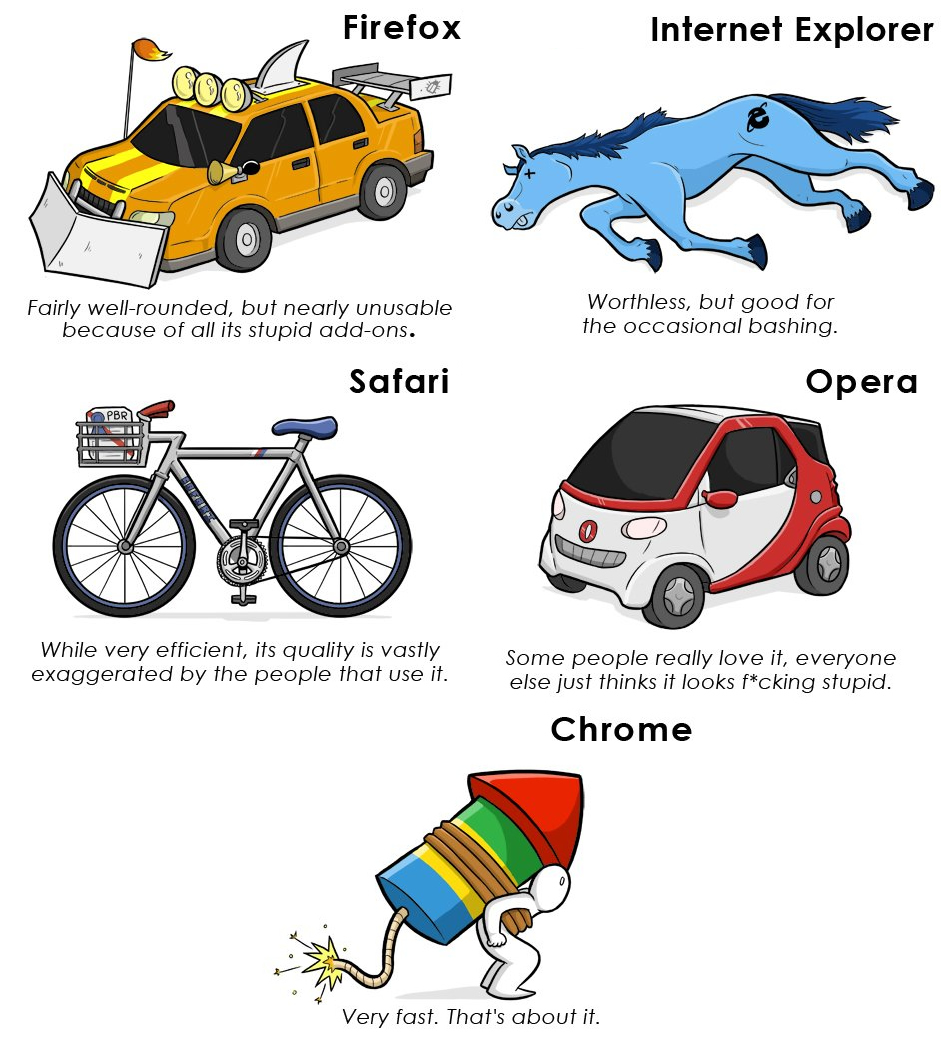
  • The folks over at <a href="http://www.techxav.com/wp-content/uploads/2010/03/browserstransportation.jpg">CollegeHumor</a> have come up with a great visualization of the five popular web browsers (Firefox, Internet Explorer, Safari, Opera, and Google Chrome) and the modes of transportation they resemble. Not surprisingly, Internet Explorer is the most-criticized browser among the five. Meanwhile, Google Chrome, which resembles a rocket as the mode of transportation, is touted "Very fast. That's about it."

    If Web Browsers Were Modes Of Transportation

    The folks over at CollegeHumor have come up with a great visualization of the five popular web browsers (Firefox, Internet Explorer, Safari, Opera, and Google Chrome) and the modes of transportation they resemble. Not surprisingly, Internet Explorer is the most-criticized browser among the five. Meanwhile, Google Chrome, which resembles a rocket as the mode of transportation, is touted "Very fast. That's about it."

    Continue Reading...

  • Although the design of the above graphic may not be as attractive as those beautiful default Mac OSX desktop wallpapers, but I personally feel that it's indeed a pretty good idea. The guy behind this desktop wallpaper cleverly places his Windows desktop icons (Firefox, Adobe, iTunes, uTorrent, etc.) neatly on the shelve, and the 'Computer' and 'Recycle bin' icon on the desktop and floor respectively. 

I personally hail this as "The Best Desktop Wallpaper, Ever!" Do you think so too?

    The Best Desktop Wallpaper, Ever! [PIC]

    Although the design of the above graphic may not be as attractive as those beautiful default Mac OSX desktop wallpapers, but I personally feel that it's indeed a pretty good idea. The guy behind this desktop wallpaper cleverly places his Windows desktop icons (Firefox, Adobe, iTunes, uTorrent, etc.) neatly on the shelve, and the 'Computer' and 'Recycle bin' icon on the desktop and floor respectively. I personally hail this as "The Best Desktop Wallpaper, Ever!" Do you think so too?

    Continue Reading...

  • Have you ever wondered the office environment where the young and zealous engineers of Facebook, Twitter, YouTube, MySpace, Flickr, and LinkedIn work in? Today we present to you guys the awesome compilation of "Inside the Offices of the Top 6 Most Popular Social Websites [PICS]".

<em>Photos courtesy of <a href="http://officesnapshots.com">OfficeSnapshots</a> & Flickr.</em>

    Top 6 Most Popular Social Websites And Their Office [PICS]

    Have you ever wondered the office environment where the young and zealous engineers of Facebook, Twitter, YouTube, MySpace, Flickr, and LinkedIn work in? Today we present to you guys the awesome compilation of "Inside the Offices of the Top 6 Most Popular Social Websites [PICS]". Photos courtesy of OfficeSnapshots & Flickr.

    Continue Reading...

  • moticons are a very clever use of standard punctuation marks to express a human emotion in text messages, informal e-mails, and instant messaging conversations between friends, family members or co-workers. However, it's so commonly used in these mediums that we sometimes don't really express it through our facial expressions. Take a look at the comic below, and you'll know.

If you would like to enforce honesty or prove your sincerity in your online communication, then you should give <a href="http://fffff.at/auto-smiley">Auto Smiley</a> a try! Here's how this ingenious software application works: it automatically detects if you're smiling using your computer's webcam, and then sends the ASCII smiley emotion to the front-most application running. It could be your Windows Live Messenger, GTalk, AIM, e-mail, whatever!

    Clever Software Automatically Detects If You’re Smiling, Then Sends Smiley Emotion To Front-Most App

    moticons are a very clever use of standard punctuation marks to express a human emotion in text messages, informal e-mails, and instant messaging conversations between friends, family members or co-workers. However, it's so commonly used in these mediums that we sometimes don't really express it through our facial expressions. Take a look at the comic below, and you'll know. If you would like to enforce honesty or prove your sincerity in your online communication, then you should give Auto Smiley a try! Here's how this ingenious software application works: it automatically detects if you're smiling using your computer's webcam, and then sends the ASCII smiley emotion to the front-most application running. It could be your Windows Live Messenger, GTalk, AIM, e-mail, whatever!

    Continue Reading...

  • This morning (GMT+8), when I attempted to visit Google.cn, I was redirected to Google.com.hk (Google Hong Kong) instead.

The page displays a sentence: "Welcome to the new home of Google in China". I've no idea whether the Chinese people can access this website. As announced by Google, Google.com.hk will provide Google Search services in Simplified Chinese without filtering any content, and the sales revenue of Google China will be dependent on the government's decision about this Hong Kong-based website.

    Google.cn Closes, Redirects to Google.com.hk

    This morning (GMT+8), when I attempted to visit Google.cn, I was redirected to Google.com.hk (Google Hong Kong) instead. The page displays a sentence: "Welcome to the new home of Google in China". I've no idea whether the Chinese people can access this website. As announced by Google, Google.com.hk will provide Google Search services in Simplified Chinese without filtering any content, and the sales revenue of Google China will be dependent on the government's decision about this Hong Kong-based website.

    Continue Reading...

  • Twitter currently has five native tongues – English, Japanese, Spanish, French, and Italian. The world's most popular micro-blogging even has plans to add German and Chinese into the list soon. Co-founder Jack Dorsey said last week during a New York gathering sponsored by ReadWriteWeb that it is just a matter of a time before Twitter will be serving the Chinese market despite numerous time-consuming obstacles to creating a Chinese Twitter, both political and technological.

Meanwhile, avid Chinese and South Korean micro-blogging users have each developed a rather controversy website, which they both claim is a third-party Twitter client and is not affiliated with Twitter.com. The Chinese version one is called <a href="http://fanfou.im/">FanFou.im</a> whereas the South Korean client is known as <a href="http://twtkr.com">TwtKR.com</a>. Unlike other English web-based Twitter clients such as iTweet  2, the design and layout of these so-called Twitter “clones” seem to be exact replicas of the original Twitter.com site.

    Two Twitter “Clones” That Might Infringe Twitter’s Trademark

    Twitter currently has five native tongues – English, Japanese, Spanish, French, and Italian. The world's most popular micro-blogging even has plans to add German and Chinese into the list soon. Co-founder Jack Dorsey said last week during a New York gathering sponsored by ReadWriteWeb that it is just a matter of a time before Twitter will be serving the Chinese market despite numerous time-consuming obstacles to creating a Chinese Twitter, both political and technological. Meanwhile, avid Chinese and South Korean micro-blogging users have each developed a rather controversy website, which they both claim is a third-party Twitter client and is not affiliated with Twitter.com. The Chinese version one is called FanFou.im whereas the South Korean client is known as TwtKR.com. Unlike other English web-based Twitter clients such as iTweet 2, the design and layout of these so-called Twitter “clones” seem to be exact replicas of the original Twitter.com site.

    Continue Reading...

  • I live in Singapore, which is about 2,800 miles (4,500 km) from China. Yet, many of us still use Baidu. No, not for searching the web. Instead, practically every pirate is using it to find pirated chinese songs with Baidu. A search engine famous for piracy? If it was in the <a href="http://en.wikipedia.org/wiki/The_Pirate_Bay">west, I think the owners would have been sued to death by now</a>.

As much as anyone can deny it, China is playing catchup with the newest programs out in the world. And the slightly weaker websites/programs still survive because of the sheer amount of people. Foreign websites may blocked in an moment's notice, and the domestic duplicates won't. Thus, creating an situation where people are using the backwater sites/programs. With the amount of traffic and foreign (often good) ideas out of the picture, this websites and programs don't really advance.

    How China Is Playing Catchup With International Companies

    I live in Singapore, which is about 2,800 miles (4,500 km) from China. Yet, many of us still use Baidu. No, not for searching the web. Instead, practically every pirate is using it to find pirated chinese songs with Baidu. A search engine famous for piracy? If it was in the west, I think the owners would have been sued to death by now. As much as anyone can deny it, China is playing catchup with the newest programs out in the world. And the slightly weaker websites/programs still survive because of the sheer amount of people. Foreign websites may blocked in an moment's notice, and the domestic duplicates won't. Thus, creating an situation where people are using the backwater sites/programs. With the amount of traffic and foreign (often good) ideas out of the picture, this websites and programs don't really advance.

    Continue Reading...