About Author: Xavier Lur

Website
http://TechXav.com
Description
Xavier is from Singapore. Having a passion in blogging and social media, he reviews Web 2.0 apps/start-ups and writes news related to social media & technology.

Posts by Xavier Lur

  • A couple of days ago, we published an <a href="http://www.techxav.com/2010/03/25/the-best-desktop-wallpaper-ever-pic/">absolutely creative desktop wallpaper</a>, which the guy cleverly places his Windows desktop icons (Firefox, Adobe, iTunes, uTorrent, etc.) neatly on the shelve, and the ‘Computer’ and ‘Recycle bin’ icon on the desktop and floor respectively.

    The Most Creative Desktop Wallpaper, Redecorated

    A couple of days ago, we published an absolutely creative desktop wallpaper, which the guy cleverly places his Windows desktop icons (Firefox, Adobe, iTunes, uTorrent, etc.) neatly on the shelve, and the ‘Computer’ and ‘Recycle bin’ icon on the desktop and floor respectively.

    Continue Reading...

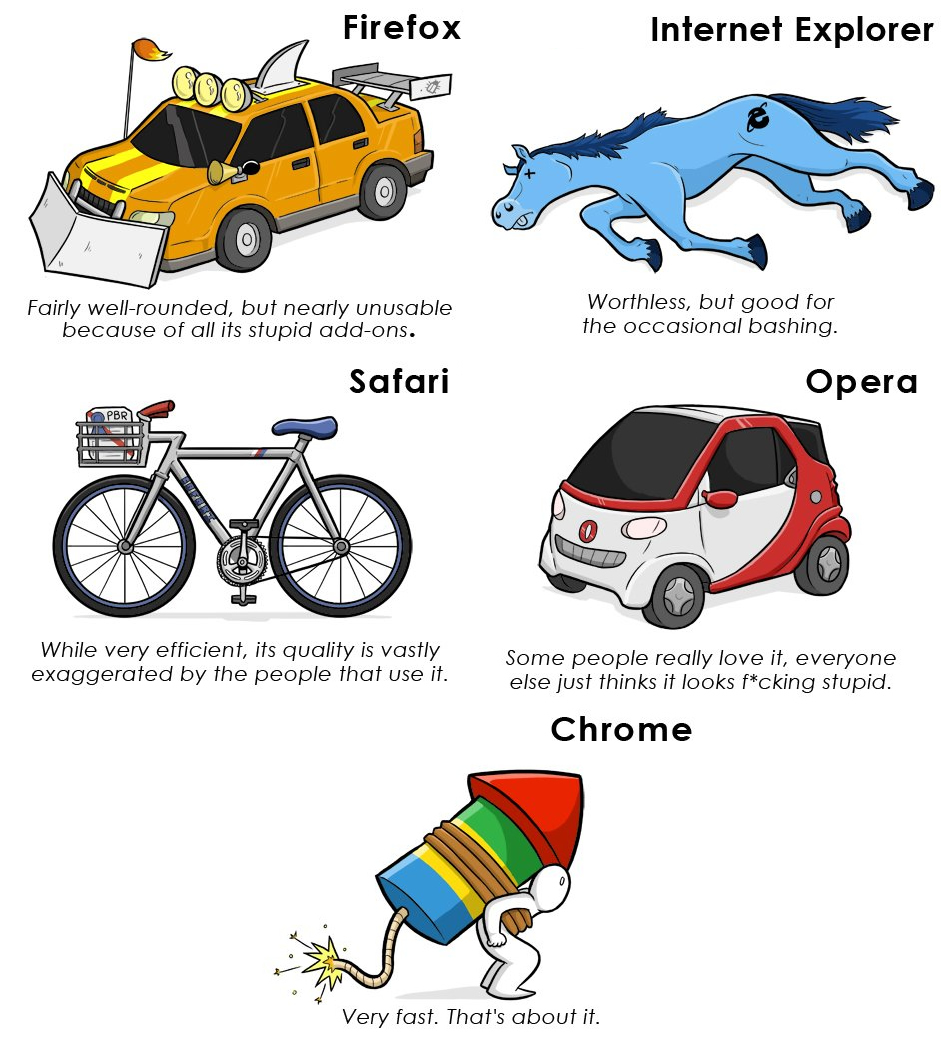
  • The folks over at <a href="http://www.techxav.com/wp-content/uploads/2010/03/browserstransportation.jpg">CollegeHumor</a> have come up with a great visualization of the five popular web browsers (Firefox, Internet Explorer, Safari, Opera, and Google Chrome) and the modes of transportation they resemble. Not surprisingly, Internet Explorer is the most-criticized browser among the five. Meanwhile, Google Chrome, which resembles a rocket as the mode of transportation, is touted "Very fast. That's about it."

    If Web Browsers Were Modes Of Transportation

    The folks over at CollegeHumor have come up with a great visualization of the five popular web browsers (Firefox, Internet Explorer, Safari, Opera, and Google Chrome) and the modes of transportation they resemble. Not surprisingly, Internet Explorer is the most-criticized browser among the five. Meanwhile, Google Chrome, which resembles a rocket as the mode of transportation, is touted "Very fast. That's about it."

    Continue Reading...

  • Although the design of the above graphic may not be as attractive as those beautiful default Mac OSX desktop wallpapers, but I personally feel that it's indeed a pretty good idea. The guy behind this desktop wallpaper cleverly places his Windows desktop icons (Firefox, Adobe, iTunes, uTorrent, etc.) neatly on the shelve, and the 'Computer' and 'Recycle bin' icon on the desktop and floor respectively. 

I personally hail this as "The Best Desktop Wallpaper, Ever!" Do you think so too?

    The Best Desktop Wallpaper, Ever! [PIC]

    Although the design of the above graphic may not be as attractive as those beautiful default Mac OSX desktop wallpapers, but I personally feel that it's indeed a pretty good idea. The guy behind this desktop wallpaper cleverly places his Windows desktop icons (Firefox, Adobe, iTunes, uTorrent, etc.) neatly on the shelve, and the 'Computer' and 'Recycle bin' icon on the desktop and floor respectively. I personally hail this as "The Best Desktop Wallpaper, Ever!" Do you think so too?

    Continue Reading...

  • Have you ever wondered the office environment where the young and zealous engineers of Facebook, Twitter, YouTube, MySpace, Flickr, and LinkedIn work in? Today we present to you guys the awesome compilation of "Inside the Offices of the Top 6 Most Popular Social Websites [PICS]".

<em>Photos courtesy of <a href="http://officesnapshots.com">OfficeSnapshots</a> & Flickr.</em>

    Top 6 Most Popular Social Websites And Their Office [PICS]

    Have you ever wondered the office environment where the young and zealous engineers of Facebook, Twitter, YouTube, MySpace, Flickr, and LinkedIn work in? Today we present to you guys the awesome compilation of "Inside the Offices of the Top 6 Most Popular Social Websites [PICS]". Photos courtesy of OfficeSnapshots & Flickr.

    Continue Reading...

  • moticons are a very clever use of standard punctuation marks to express a human emotion in text messages, informal e-mails, and instant messaging conversations between friends, family members or co-workers. However, it's so commonly used in these mediums that we sometimes don't really express it through our facial expressions. Take a look at the comic below, and you'll know.

If you would like to enforce honesty or prove your sincerity in your online communication, then you should give <a href="http://fffff.at/auto-smiley">Auto Smiley</a> a try! Here's how this ingenious software application works: it automatically detects if you're smiling using your computer's webcam, and then sends the ASCII smiley emotion to the front-most application running. It could be your Windows Live Messenger, GTalk, AIM, e-mail, whatever!

    Clever Software Automatically Detects If You’re Smiling, Then Sends Smiley Emotion To Front-Most App

    moticons are a very clever use of standard punctuation marks to express a human emotion in text messages, informal e-mails, and instant messaging conversations between friends, family members or co-workers. However, it's so commonly used in these mediums that we sometimes don't really express it through our facial expressions. Take a look at the comic below, and you'll know. If you would like to enforce honesty or prove your sincerity in your online communication, then you should give Auto Smiley a try! Here's how this ingenious software application works: it automatically detects if you're smiling using your computer's webcam, and then sends the ASCII smiley emotion to the front-most application running. It could be your Windows Live Messenger, GTalk, AIM, e-mail, whatever!

    Continue Reading...

  • Twitter currently has five native tongues – English, Japanese, Spanish, French, and Italian. The world's most popular micro-blogging even has plans to add German and Chinese into the list soon. Co-founder Jack Dorsey said last week during a New York gathering sponsored by ReadWriteWeb that it is just a matter of a time before Twitter will be serving the Chinese market despite numerous time-consuming obstacles to creating a Chinese Twitter, both political and technological.

Meanwhile, avid Chinese and South Korean micro-blogging users have each developed a rather controversy website, which they both claim is a third-party Twitter client and is not affiliated with Twitter.com. The Chinese version one is called <a href="http://fanfou.im/">FanFou.im</a> whereas the South Korean client is known as <a href="http://twtkr.com">TwtKR.com</a>. Unlike other English web-based Twitter clients such as iTweet  2, the design and layout of these so-called Twitter “clones” seem to be exact replicas of the original Twitter.com site.

    Two Twitter “Clones” That Might Infringe Twitter’s Trademark

    Twitter currently has five native tongues – English, Japanese, Spanish, French, and Italian. The world's most popular micro-blogging even has plans to add German and Chinese into the list soon. Co-founder Jack Dorsey said last week during a New York gathering sponsored by ReadWriteWeb that it is just a matter of a time before Twitter will be serving the Chinese market despite numerous time-consuming obstacles to creating a Chinese Twitter, both political and technological. Meanwhile, avid Chinese and South Korean micro-blogging users have each developed a rather controversy website, which they both claim is a third-party Twitter client and is not affiliated with Twitter.com. The Chinese version one is called FanFou.im whereas the South Korean client is known as TwtKR.com. Unlike other English web-based Twitter clients such as iTweet 2, the design and layout of these so-called Twitter “clones” seem to be exact replicas of the original Twitter.com site.

    Continue Reading...

  • It's now March 21, 2010 (in most parts of the world). Guess what special occasion today is? Well, it's Twitter's 4th birthday! Back in 2006, Twitter was only a SMS service/micro-blogging platform with less than a thousand users. And today, Twitter has evolved to become the 12th most visited website in the world, according to web information company <a href="http://www.alexa.com/siteinfo/twitter.com">Alexa</a>.

In this post, I've gathered information from various sources around the web such as the official <strong><a href="http://blog.twitter.com" target="_blank">Twitter blog</a></strong> and <strong><a href="http://wikipedia.org" target="_blank">Wikipedia</a></strong> to present you guys The History of Twitter (March 21 2006 - Today). Let's activate the way back machine!

    Happy 4th Birthday Twitter! 2006-Today [PICS]

    It's now March 21, 2010 (in most parts of the world). Guess what special occasion today is? Well, it's Twitter's 4th birthday! Back in 2006, Twitter was only a SMS service/micro-blogging platform with less than a thousand users. And today, Twitter has evolved to become the 12th most visited website in the world, according to web information company Alexa. In this post, I've gathered information from various sources around the web such as the official Twitter blog and Wikipedia to present you guys The History of Twitter (March 21 2006 - Today). Let's activate the way back machine!

    Continue Reading...

  • Developed by Amit Agarwal from <a href="http://labnol.org">Digital Inspiration</a>, <a href="http://www.sleepingtime.org">SleepTime.org</a> is a simple yet clever tool that tells you when your favorite Twitter celebrities or friends sleep. This may sound rather creepy but it actually works quite accurately to a certain extent. The system analyzes the past tweets of a user and when he or she stays least active on Twitter. After which, the algorithm will then determine his or her sleeping schedule and display it in a sleep chart. 

However, the results won't be accurate if you only publishes a few tweets a day. Another likely reason for your sleep chart to appear way off the mark is due to the settings of your time zone. You've to specify the correct time zone in your Twitter account settings.

    Clever Tool Tells You The Sleeping Schedule Of Your Twitter Friends
    Developed by Amit Agarwal from Digital Inspiration, SleepTime.org is a simple yet clever tool that tells you when your favorite Twitter celebrities or friends sleep. This may sound rather creepy but it actually works quite accurately to a certain extent. The system analyzes the past tweets of a user and when he or she stays least active on Twitter. After which, the algorithm will then determine his or her sleeping schedule and display it in a sleep chart. However, the results won't be accurate if you only publishes a few tweets a day. Another likely reason for your sleep chart to appear way off the mark is due to the settings of your time zone. You've to specify the correct time zone in your Twitter account settings.

    Continue Reading...